
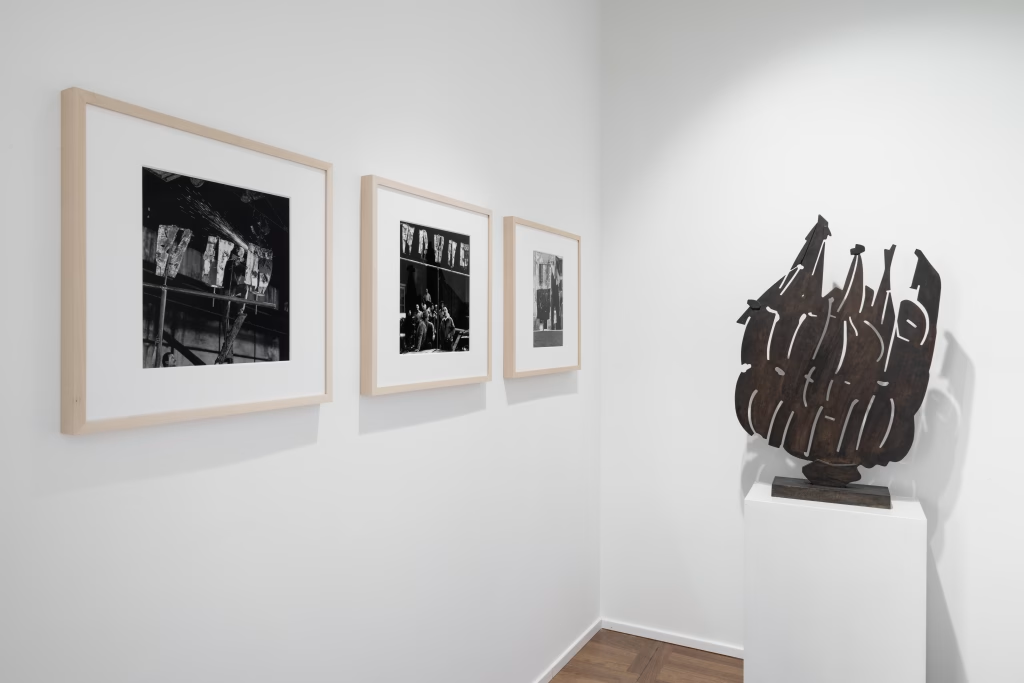
Cortesi Gallery is pleased to announce the opening of the exhibition Ugo Mulas – Pietro Consagra – Arnaldo Pomodoro, curated by Alberto Salvadori, at the gallery’s Milan venue. The exhibition represents the third chapter in the collaboration between the gallery and the curator—an ongoing research project dedicated to the relationships and dialogues that shaped the Italian art scene in the postwar period. The exhibition has been realised with the support of the Archivio Ugo Mulas, which has made the artist’s photographs available to the gallery.
The artistic trajectory and close personal relationship that united these three central figures of the twentieth century form the core of the project. Ugo Mulas shared with Pietro Consagra and Arnaldo Pomodoro a deep affinity of intentions and visions regarding life and art. Their relationship, grounded in continuous intellectual and human proximity, developed within a context in which the boundary between artistic experience and everyday life was constantly traversed.
Mulas met Consagra in Venice in 1960, on the occasion of the Biennale, when the sculptor was awarded the International Grand Prize for Sculpture. From that moment on, their partnership continued uninterrupted, giving rise to moments of intense reflection and mutual understanding. Arnaldo Pomodoro has been a constant presence in the life and work of the photographer since 1959, with whom he maintains an ongoing collaboration and uninterrupted dialogue. As Mulas himself recalled: “There is one artist I have worked with more than any other: Arnaldo Pomodoro […] and for twelve years I have photographed all his sculptures. Every time he has something ready, he calls me, and I go.”
The exhibition may appear to be a dialogue between two sculptors and a photographer; in reality, it is something more: a necessarily condensed account of a shared intimacy. The photographs convey the depth of knowledge and familiarity that bound the three protagonists, taking on an additional autobiographical dimension. This is neither art photography in the traditional sense nor mere documentation: what emerges is a true reciprocal exchange, each within their own role.
Mulas’s photography takes shape as a critical act, free from any dogmatic position. In this case, engaging in critique means entering the work, knowing how to read it, assimilate it, and return it—going beyond the surface of the visible. His work stems from a deep desire to understand and share the creative process, making manifest what normally remains invisible: the artist’s gesture, the time of the work, its becoming. Mulas is drawn to the process—both interior and material—that renders the work visible. For him, photographing art means entering the very act of artistic making, capturing and conveying it. His images construct a kind of chronicle, both processual and synchronic, of the elements that compose the work, anticipating reflections that would become central from the late 1960s onward, such as those concerning the relationship between artwork, space, and experience.
Consagra and Pomodoro were fundamental interlocutors in the development of this research, contributing to the definition of what Mulas called the “right photograph”: not the “beautiful” photograph, but the necessary, essential one—capable of conveying the work through a process of understanding filtered by shared culture and experience.
The exhibition path brings together a selection of photographs by Ugo Mulas in relation to works by Pietro Consagra and Arnaldo Pomodoro. The images do not merely represent the sculptures but explore their structure, their relationship with space, and their environmental dimension—understood not as a simple container, but as a place transformed by the very presence of the work.
Years later, it is clear that the relationship between Mulas and the artists was grounded in a form of mutual intellectual support, an ongoing conversation aimed at achieving the most rigorous result possible, free from compromise. This three-way dialogue also reflects a historical and cultural context in which artists, photographers, and critics shared experiences, ideas, and visions: a world in which life and art coincided.
The works on display constitute an intense and focused testimony to this shared path, conveying the sense of a common experience that runs through the 1960s.
In addition to the Archivio Ugo Mulas, thanks are extended to the Archivio Pietro Consagra and the Fondazione Arnaldo Pomodoro for their valuable support.