

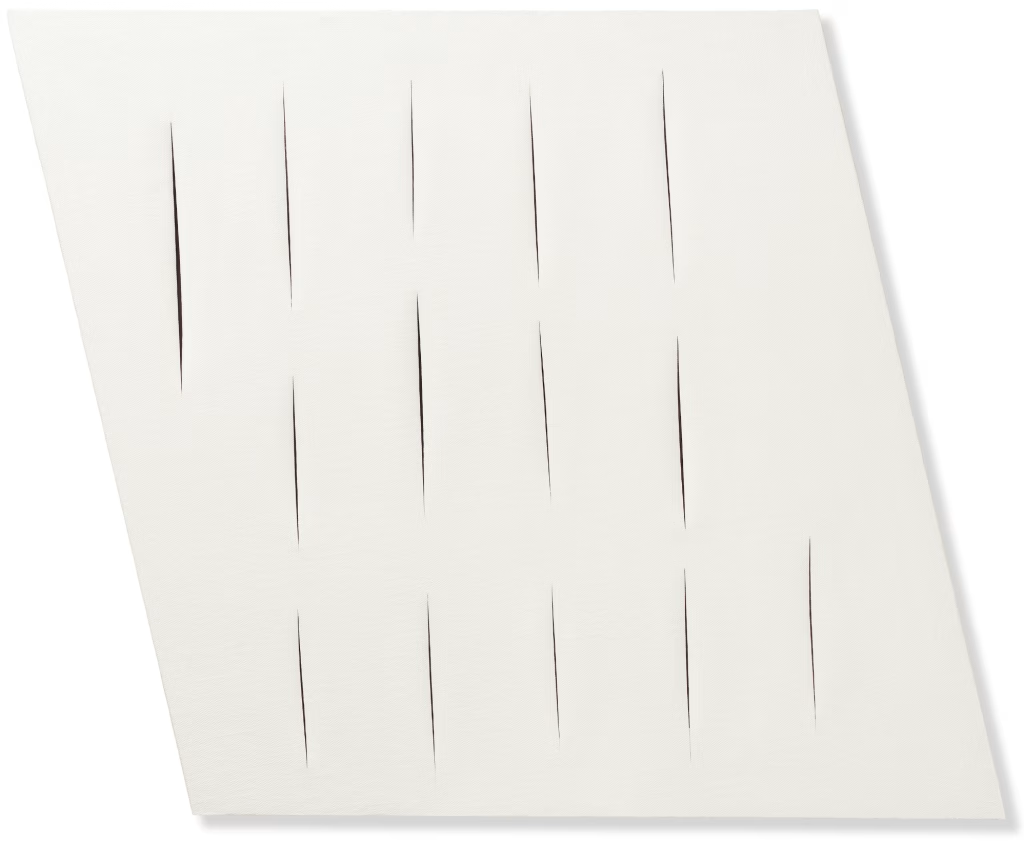
Lucio Fontana (1899 Rosario de Santa Fé, Argentina – 1968 Varese, Italy) was a pioneering Italian-Argentinian artist, renowned as the founder of the Spatialism movement and a key figure in 20th-century avant-garde art.
Fontana was born in Argentina but moved to Milan with his family in 1905, where he grew up and studied until 1922. He returned to Argentina in the early 1920s, working as a sculptor in his father’s studio before establishing his own practice. In 1926, he participated in the first exhibition of Nexus, a group of young Argentinian artists, marking his early engagement with modernist experimentation.
Returning to Milan, Fontana enrolled at the Accademia di Belle Arti di Brera, where he studied for two years. In 1931 he held his first solo show at Galleria Il Milione in Milan, joining a group of abstract Italian sculptors and traveling to Paris in 1935 to work with Abstraction-Création. During this period he refined his ceramic techniques in Albisola, Italy, and at the Sèvres manufactory in France. In 1939, he became a member of Corrente, a Milanese expressionist group.
After a brief period in Buenos Aires, Fontana returned to Milan in 1947, where he co-signed the Primo Manifesto dello Spazialismo with writers and philosophers. This marked the beginning of his exploration of space in art, first expressed in his ceramic works and later in his iconic Concetti spaziali (Spatial Concepts, 1949–1960). In 1949, he created the first of his Buchi (holes) paintings, puncturing canvases to integrate actual space into the pictorial surface. Around the same time, he began experimenting with neon lighting, fluorescent painting, and shapeless spatial sculptures, aiming to dissolve the boundaries between painting, sculpture, and environment.
Throughout his career, Fontana continuously explored new effects such as slashing, perforating, and manipulating materials, fundamentally transforming the relationship between artwork, space, and viewer perception. His work influenced generations of contemporary artists and paved the way for movements such as Minimalism and Kinetic Art.
Fontana’s work has been celebrated internationally in numerous retrospectives and exhibitions, including the Solomon R. Guggenheim Museum, New York (1977, 2006–07); Centre Georges Pompidou, Paris; Kunsthalle Frankfurt (1996); Museo Nacional Centro de Arte Reina Sofía, Madrid (1998); Hayward Gallery, London (1999); and the Peggy Guggenheim Collection, Venice.
For information on available works by the artist, please contact the gallery.