
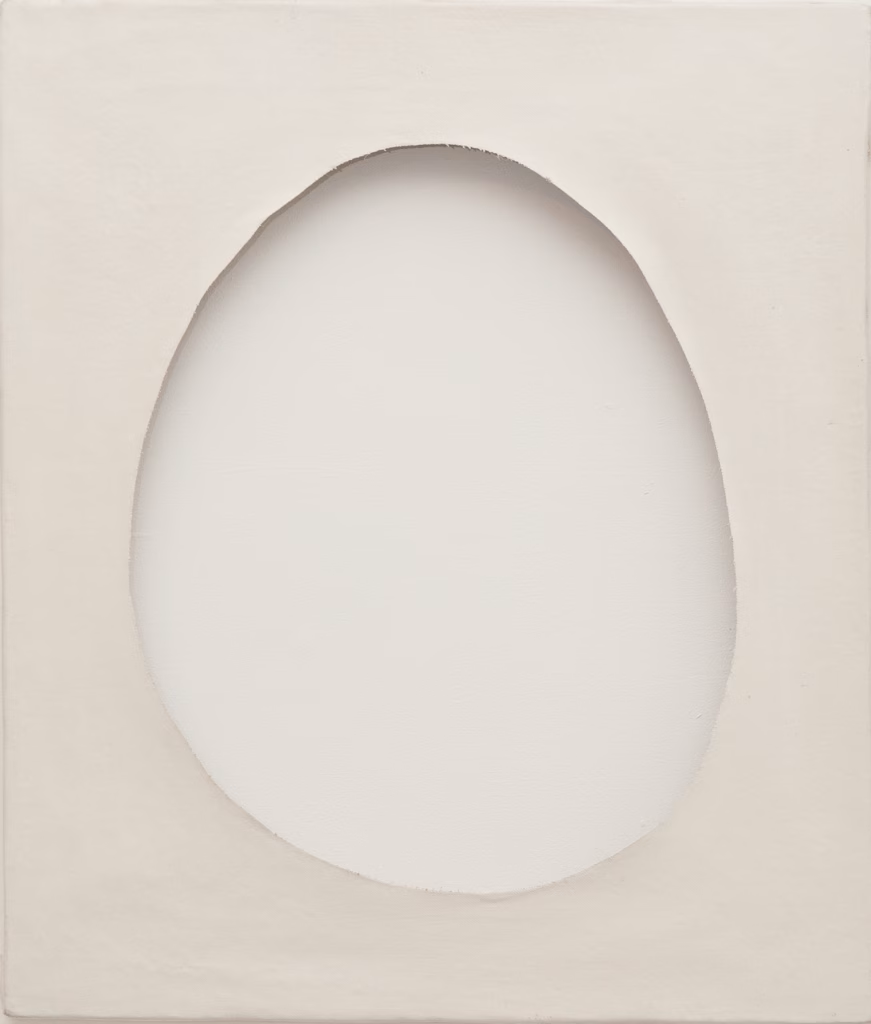
Dadamaino (born Eduarda Emilia Maino, 1930 – 2004 Milan, Italy) is regarded as a central figure of the post-war Italian avant-garde, known for a rigorous and inventive body of work that spans perceptual experimentation, optical research and linguistic investigation. A self-taught painter, she turned to art after completing a medical degree. In 1957 she met Piero Manzoni, who became a life-long friend and an important point of reference within the Milanese neo-avant-garde. The following year she joined the vibrant artistic scene of Milan and produced her first significant cycle, the Volumi—canvases punctured by elliptical or circular openings that echo Lucio Fontana’s Buchi while establishing her own spatial language. In 1958 she also held her first solo exhibition at Galleria dei Bossi in Milan.
Her adhesion to the Azimuth and ZERO groups, and her affinity with Spatialist and Minimalist figures such as Fontana and Yves Klein, deepened her engagement with the relationship between artwork and surrounding space, leading her to explore shape, void and perception as autonomous artistic subjects. In 1961, during a group exhibition in the Netherlands, her name was inadvertently written as a single word—Dadamaino—a form she would officially adopt from 1963–64 onward.
In 1962 she exhibited at the Stedelijk Museum in Amsterdam alongside the leading artists of the Nul group, and in the same year joined the newly founded Nouvelle Tendance movement, which included Getulio Alviani, Bruno Munari, Jesús Rafael Soto and Enzo Mari. In these years she developed a series of optical-dynamic objects, followed by the cycle Ricerca del colore (1966–68), an analytical exploration of chromatic combinations based on the solar spectrum.
From the 1970s onward, Dadamaino devoted herself to perceptual and optical experimentation associated with Op Art, creating paintings based on visual oscillations and structured illusions. In the 1980s her research shifted towards semiotics: she began to draw minute signs, pseudo-letters and ideogram-like symbols obsessively across paper and canvas. These same glyphs reappear in one of her most important cycles, I fatti della vita, presented at the 1980 Venice Biennale. A major retrospective followed at the Padiglione d’Arte Contemporanea, Milan (1983), and she returned to the Venice Biennale in 1990. A comprehensive retrospective was later organized by the Bochum Museum in 2000.
Dadamaino’s work is held in major museum collections worldwide, including Tate Modern, London; the Peggy Guggenheim Collection, Venice; and the Foundation for Concrete Art, Germany.
For information on available works by the artist, please contact the gallery.