
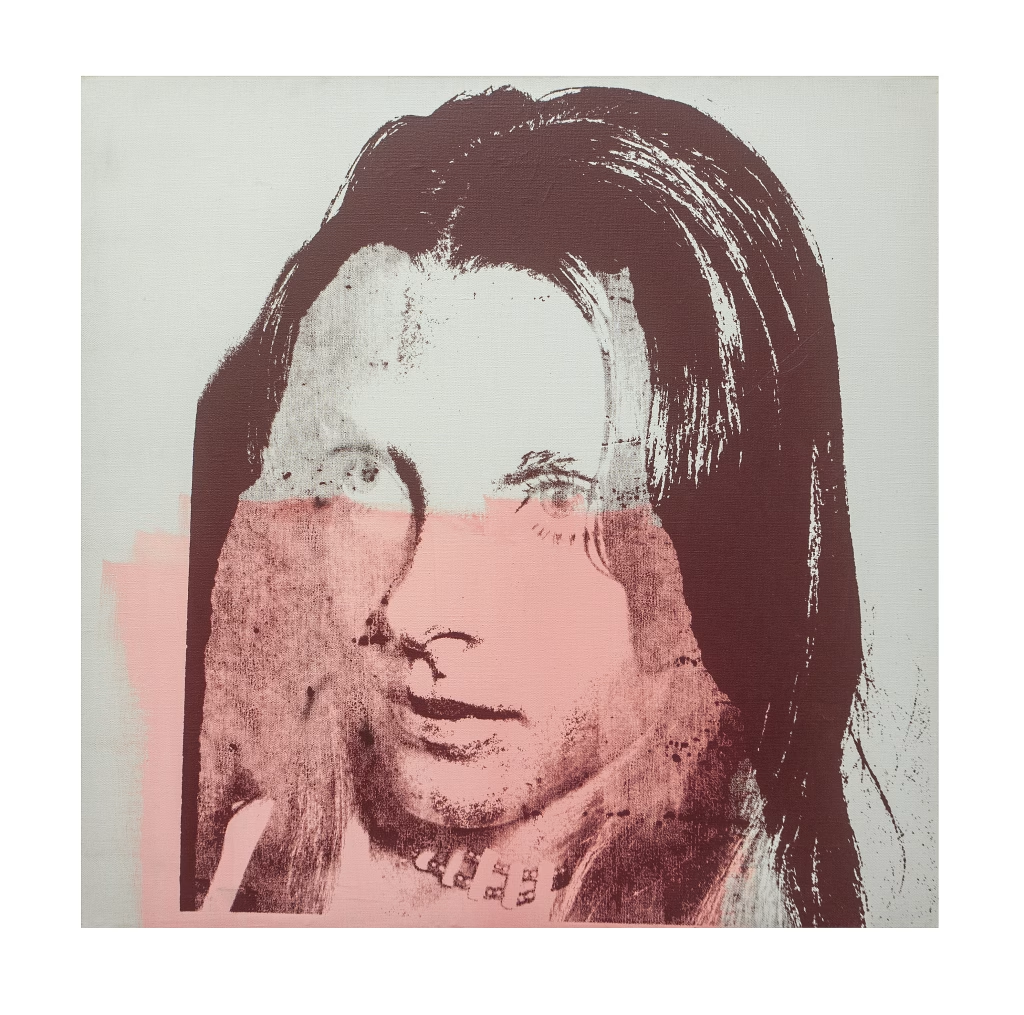
Andy Warhol (1928 Pittsburgh, USA – 1987 New York, USA) is widely regarded as one of the most influential and transformative figures of post-war art, a pioneer whose exploration of mass media, celebrity culture, and mechanical reproduction reshaped the very definition of artistic practice in the twentieth century. His work—simultaneously cool, seductive, and conceptually incisive—remains a cornerstone of global visual culture.
After studying pictorial design at Carnegie Tech (now Carnegie Mellon University), Warhol moved to New York in 1949, quickly establishing himself as one of the city’s most successful commercial illustrators. His transition to fine art in the early 1960s coincided with the rise of Pop Art, within which he emerged as its most emblematic voice. By adopting imagery from advertising, newspapers, cinema, and consumer goods—and by employing techniques such as silkscreen printing—Warhol questioned the boundaries between high and low culture, authorship, originality, and the role of the artist in an age of mass production.
A decisive moment came in 1962 with the creation of his now-iconic Campbell’s Soup Cans, Marilyns, and Disasters, works that established the visual and conceptual vocabulary that would define his career. Soon after, Warhol founded The Factory, his legendary studio where painting, film, music, performance, and celebrity intersected in a unique creative ecosystem. During this period he produced hundreds of films, including Empire and Screen Tests, which expanded his inquiry into duration, presence, and portraiture.
Throughout the 1960s and 1970s, Warhol exhibited widely across the United States and Europe, with major presentations at the Institute of Contemporary Art in Philadelphia, the Pasadena Art Museum, and the Moderna Museet in Stockholm. His practice evolved to include large-scale portraits of cultural and political figures, collaborative projects with musicians and performers, and ambitious series such as the Mao, Skulls, and Hammer and Sickle works. Retrospectives at institutions such as the Whitney Museum of American Art and the Museum of Modern Art further cemented his international stature.
Warhol continued to innovate into the 1980s, producing series like The Last Supper in Milan and engaging deeply with themes of religion, abstraction, and late-capitalist iconography. He passed away in New York in 1987. Today, his legacy is represented in major museums worldwide—including MoMA, the Whitney, the Tate, the Centre Pompidou, and the Andy Warhol Museum in Pittsburgh—and his influence remains foundational to contemporary understandings of media, identity, and the circulation of images.
For information on available works by the artist, please contact the gallery.