Cortesi Gallery presents Il segno e lo sguardo. Featuring a Wunderkammer of Drawings and Photographs from Private Collections, opening on Tuesday, 27 October 2026 at its Milan gallery. Bringing together painting, sculpture, drawing and photography, the exhibition explores how artists transform visual experience into a personal language: the body becomes line, colour becomes rhythm, and matter becomes mark.
Through works from different periods and artistic perspectives, the exhibition connects the gesture that generates a form with the gaze that interprets it. Juxtapositions reveal correspondences between surfaces, structures and images, inviting visitors to continually adjust their way of looking: from the distance required by a large painting to the intimacy of a drawing, from the physical presence of a sculpture to the framing of a photograph.
In the first two rooms, the dialogue between Giuseppe Santomaso and Arnaldo Pomodoro introduces this enquiry through their approaches to materials. In Oltre il concetto, forms and traces emerge from a layered pictorial surface, retaining an evocative relationship with space and the memory of things seen. In Stele, I, the bronze opens to reveal incisions and internal structures. In both works, the mark takes on a constructive role, giving matter rhythm and depth.
Works by Giuseppe Capogrossi, Gastone Novelli and Piero Dorazio develop this enquiry through different ways of organising the surface. In Capogrossi’s Superficie 144, the mark establishes an autonomous grammar; in Novelli’s At vespers, it approaches writing; in Dorazio’s Like a caress, colour becomes a web of luminous relationships. These works offer distinct responses to the possibility of translating perception into a visual order.
In Fausto Melotti’s Contrappunto XIII, line enters space through intervals, balance and lightness. Pietro Consagra’s bronzes from the Racconto del demonio series introduce an exploration of frontality and the articulation of planes. Ugo Mulas’s photograph, taken at the Italsider steelworks in Savona in 1962, brings one artist’s perspective on another’s practice into this dialogue, revealing the relationship between sculpture, materials and the process of making.
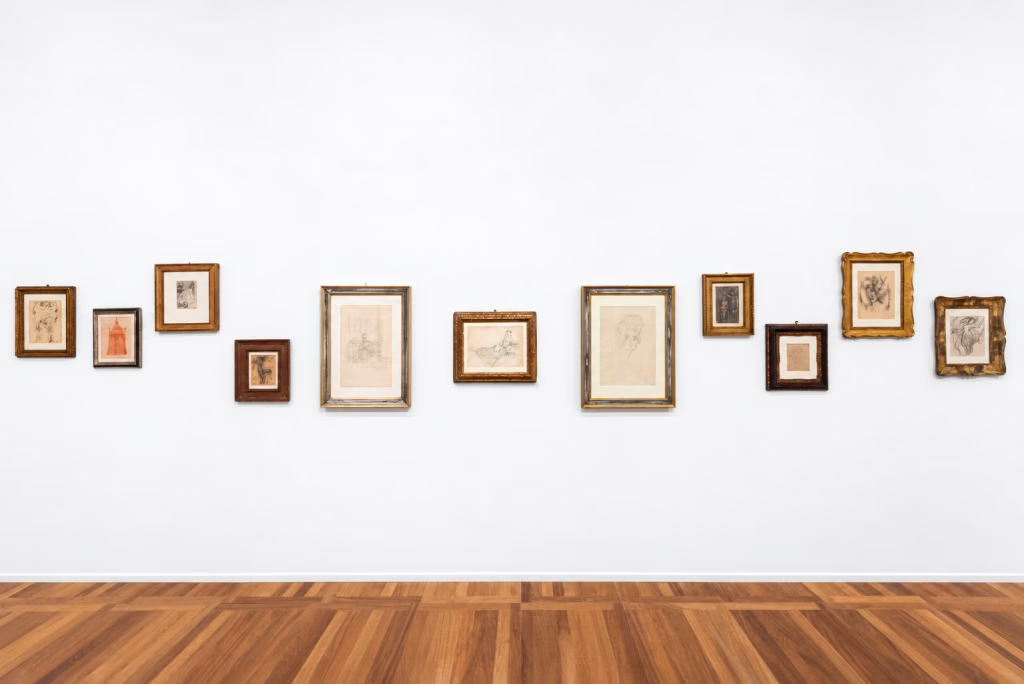
The third room houses a Wunderkammer of works on paper from private collections. The intimate scale of the selection encourages close, unhurried observation, allowing visitors to follow variations in line and the immediacy of the relationship between thought and gesture. Drawing reveals how each artist searches for form, offering a close encounter with their individual language.
The human figure is one of the central threads running through this selection. In works by Paul Gauguin, Gustav Klimt, Henri Matisse, Fernand Léger, Ernst Ludwig Kirchner and Alberto Giacometti, bodies, faces and postures convey markedly different sensibilities. A group of works by Mario Sironi broadens this dialogue, from the construction of the figure to the composition through fragments in the collage Il dubbio. Massimo Campigli and Jean Dubuffet further explore the subject through processes of simplification and transformation, while Carlo Carrà’s Costruzioni a ritmi semplici (ritmi melodici) connects drawing to the investigation of rhythm that runs throughout the exhibition.
In the fourth room, the exhibition opens onto the relationship between image, representation and landscape. Nine photographs by Luigi Ghirri explore everyday places, spaces devoted to art, and images already present in the world. From his early investigations of the 1970s to photographs of Galleria Parmiggiani, Teatro Valli and Aldo Rossi’s studio, his gaze selects and frames, questioning the boundaries between things and their representations.
Within this context, Kenneth Noland’s Le Joli Mot returns attention to colour and its capacity to articulate the surface and guide perception. In Mimmo Rotella’s Venere Imperiale, the reproduced image becomes pictorial material, inviting a fresh reading. The project for Running Fence by Christo and Jeanne-Claude ultimately extends the mark into the landscape: drawing and collage make an imagined transformation of the terrain visible before its realisation.
The Mark and the Gaze offers a journey between the physical presence of artworks and the intimacy of the processes that generate them. Their provenance from private collections also provides an opportunity to discover works less frequently accessible to the public. Through their proximity, each work retains its individuality while offering new ways to recognise how an experience, a thought or a vision can become form.