
Vincenzo Agnetti (1926 – 1981 Milan, Italy) is regarded as one of the most incisive and intellectually rigorous figures of Italian post-war conceptual art, celebrated for his ability to interweave language, technology, and systems of communication into a coherent and radical artistic practice.
After studying at the Brera Academy and taking his first steps within the Milanese art scene, Agnetti moved to South America in the late 1940s, pausing his artistic activity for nearly a decade while working in the industrial and technical sector. Upon returning to Italy in the early 1960s, he became closely connected with the most experimental circles of the period, collaborating with artists such as Piero Manzoni and engaging with emerging currents linked to Arte Povera and conceptual research.
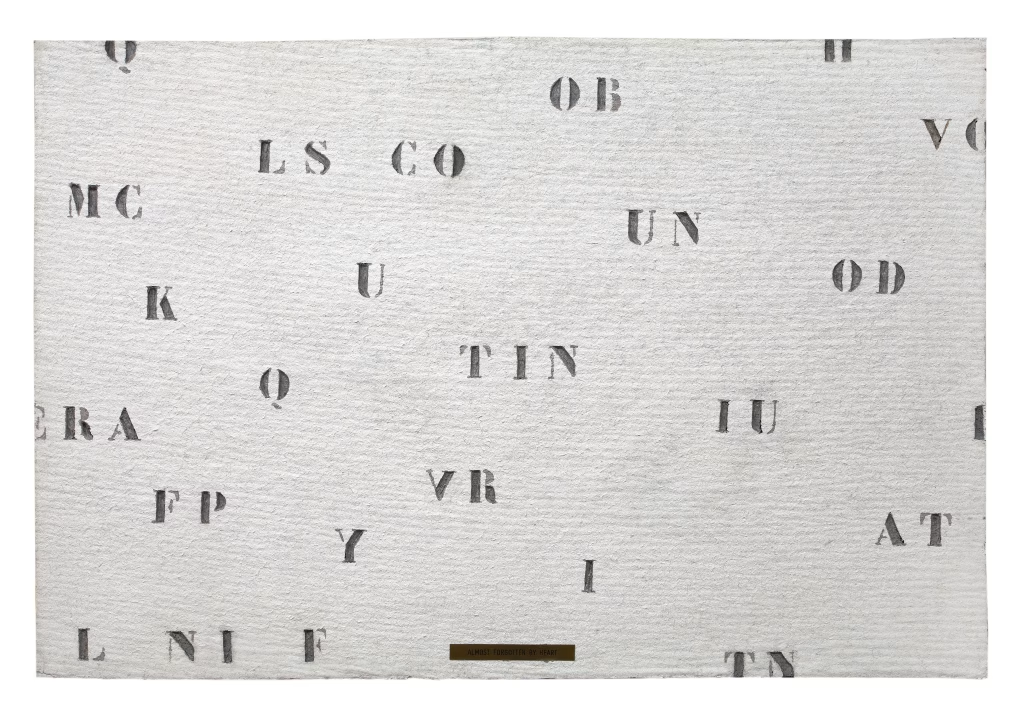
A pivotal turning point came in 1967, when Agnetti began developing his celebrated macchine celibi (bachelor machines), devices that probe the logic of perception and the structures of language. In these same years he introduced the first of his Feltri (Felts)—felt panels on which words, phrases, and portraits are painted or burned into the surface. These works, which combine material tactility with linguistic paradox, represent one of his most original contributions, using text as both image and thought to question the very mechanisms by which meaning is constructed.
Throughout the 1960s and 1970s, Agnetti exhibited widely in Italy and abroad, presenting his work at institutions such as the Galleria Nazionale d’Arte Moderna in Rome, the Museum of Contemporary Art in Chicago, Galleria Toselli and Studio Marconi in Milan, and taking part in major international exhibitions, including Documenta 5 (1972) and multiple editions of the Venice Biennale. His practice resonated strongly within debates on analytical and linguistic art, earning him a central role in the evolution of conceptualism in Europe.
Significant retrospectives followed, among them the landmark exhibition at the Rotonda della Besana in Milan in 1981, shortly before his death. Agnetti passed away in Milan that same year. His legacy continues to shape contemporary conceptual practices and is today represented in the collections of major international museums, including the Centre Pompidou in Paris, the Museo del Novecento in Milan, MART in Rovereto, MACBA in Barcelona, and numerous institutions throughout Europe and the United States.
For information on available works by the artist, please contact the gallery.