
Jesús Rafael Soto (1923 Ciudad Bolívar, Venezuela – 2005 Paris, France) was one of the most influential kinetic artists of the 20th century.
He began his artistic career at a very young age, painting posters for local movie theatres. In 1942, he received a scholarship to study art and art history at the Escuela de Artes Plásticas in Caracas, where he met fellow students such as Carlos Cruz-Diez, Mercedes Pardo, Omar Carreño, and Alejandro Otero. During this period, he experimented with Cubist-inspired painting and engaged actively with avant-garde ideas in the Taller Libre de Arte, participating in discussions and exhibitions. Soto held his first solo show at the Taller in 1949.
From 1947 to 1950, Soto directed the Escuela de Bellas Artes de Maracaibo, and in 1950 he moved to Paris on a grant, joining a vibrant artistic community around the Salon des Réalités Nouvelles and the Galerie Denise René. In Paris, Soto reconnected with old friends and collaborated with leading artists including Alexander Calder, Jean Tinguely, Victor Vasarely, and his Venezuelan colleagues Otero and Pardo. Influenced by Cubism, Constructivism, Mondrian, Malevich, and Kandinsky, he began exploring ways to transform painting into a dynamic, perceptual experience, emphasizing movement, viewer interaction, and spatial perception.
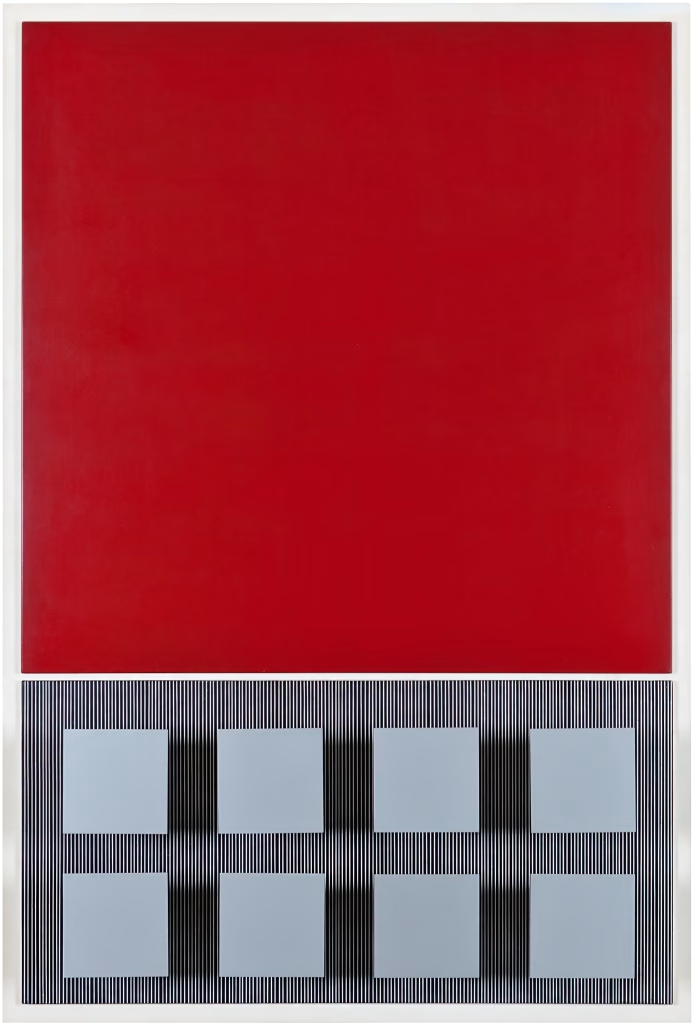
In 1952, he participated in the Proyecto de Integración de las Artes at the Universidad Central de Venezuela, directed by architect Carlos Raúl Villanueva. The project integrated avant-garde art with architecture and became a landmark of mid-century Latin American modernism. Inspired by serialism in modern music, Soto began developing his series of “serial works,” where repetition and rhythm generate optical vibration.
During the 1960s, Soto increasingly minimized color, focusing on line, vibration, and dematerialization through hanging and mobile elements. He also pioneered haptic art, creating works designed to be physically touched by viewers. His most famous contribution to this approach is the Penetrables series (1967), immersive, interactive structures made of hanging metal and plastic rods that the audience can walk through, producing kinetic and sensory experiences.
Soto’s work constantly explored the relationship between perception, movement, and participation. His artworks have been shown in major international museums and galleries, including the Centre Pompidou, the Guggenheim Museum, and the Museum of Modern Art, New York, and he played a key role in defining the international kinetic and op art movements.
Jesús Rafael Soto died in Paris in 2005, leaving a profound legacy in the field of kinetic and participatory art.
For information on available works by the artist, please contact the gallery.