
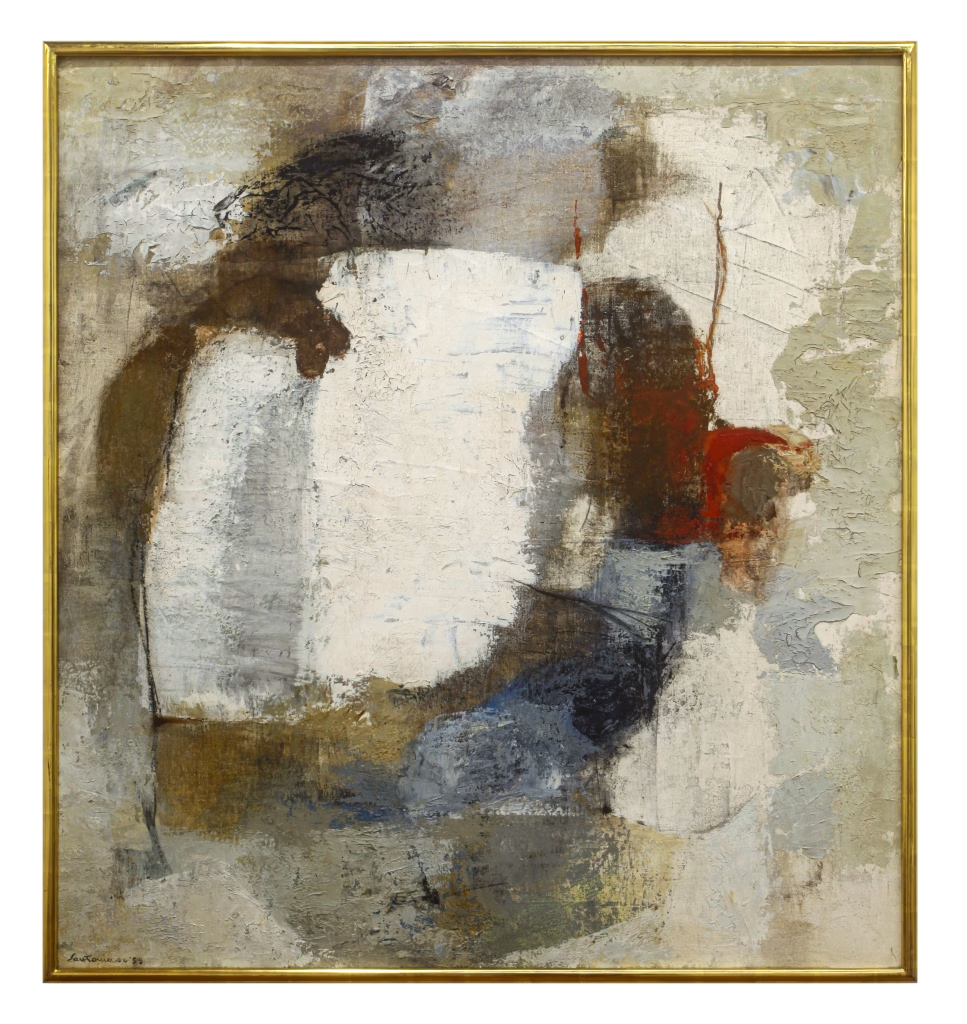
Giuseppe Santomaso (1907 – 1990 Venice, Italy) was a seminal figure in post-war Italian art, known for his innovative synthesis of abstraction and figuration. Born into a family of goldsmiths and jewelers, he initially trained as a jeweler but soon devoted himself entirely to painting, following his artistic passion.
Santomaso first participated in the Venice Biennale in 1934. In 1937, trips to the Netherlands and Paris exposed him to contemporary European avant-garde movements. His early solo shows included Galerie Rive Gauche, Paris (1939) and Galleria Genova, Italy (1940). A pivotal moment came in 1946, when he met Peggy Guggenheim, establishing a lifelong friendship and professional rapport, and signed the manifesto of the Nuova Secessione Artistica Italiana, later known as the Fronte Nuovo delle Arti. That same year, he participated in the group’s first exhibition at Galleria della Spiga, Milan.
During the late 1940s, Santomaso developed the Finestre series, exploring the interplay of structure, light, and perspective, marking a key stage in his artistic evolution. His international recognition grew through participation in the São Paulo Biennale (1951, 1953/54, 1961) and Documenta in Kassel (1955, 1959, 1964), as well as his first U.S. solo show at the Grace Borgenicht Gallery, New York (1957), which connected him with Abstract Expressionism.
In the 1960s, long stays in Poland, Spain, and Puglia influenced his work, while the 1966 Florence flood inspired the Omaggio al Crocifisso di Cimabue, signaling a shift toward pictorial Minimalism. In 1969 he began a long collaboration with Galleria Blu, Milan, which became his exclusive representative, later renewed under Luca Palazzoli. Notable works from this period include the artist’s book An Angle (1972) and the Lettere a Palladio series (1977–78), exhibited at the Fundació Joan Miró, Barcelona, and Staatsgalerie Moderner Kunst, Munich (1979).
Santomaso continued to explore new formal and chromatic possibilities throughout the 1980s, culminating in his final Venice Biennale participation in 1988, which revisited his native city through fresh perspectives and colors.
His work is celebrated for its rigorous engagement with abstraction, its poetic evocation of Venice, and its profound dialogue with both Italian and international modernism.
For information on available works by the artist, please contact the gallery.