

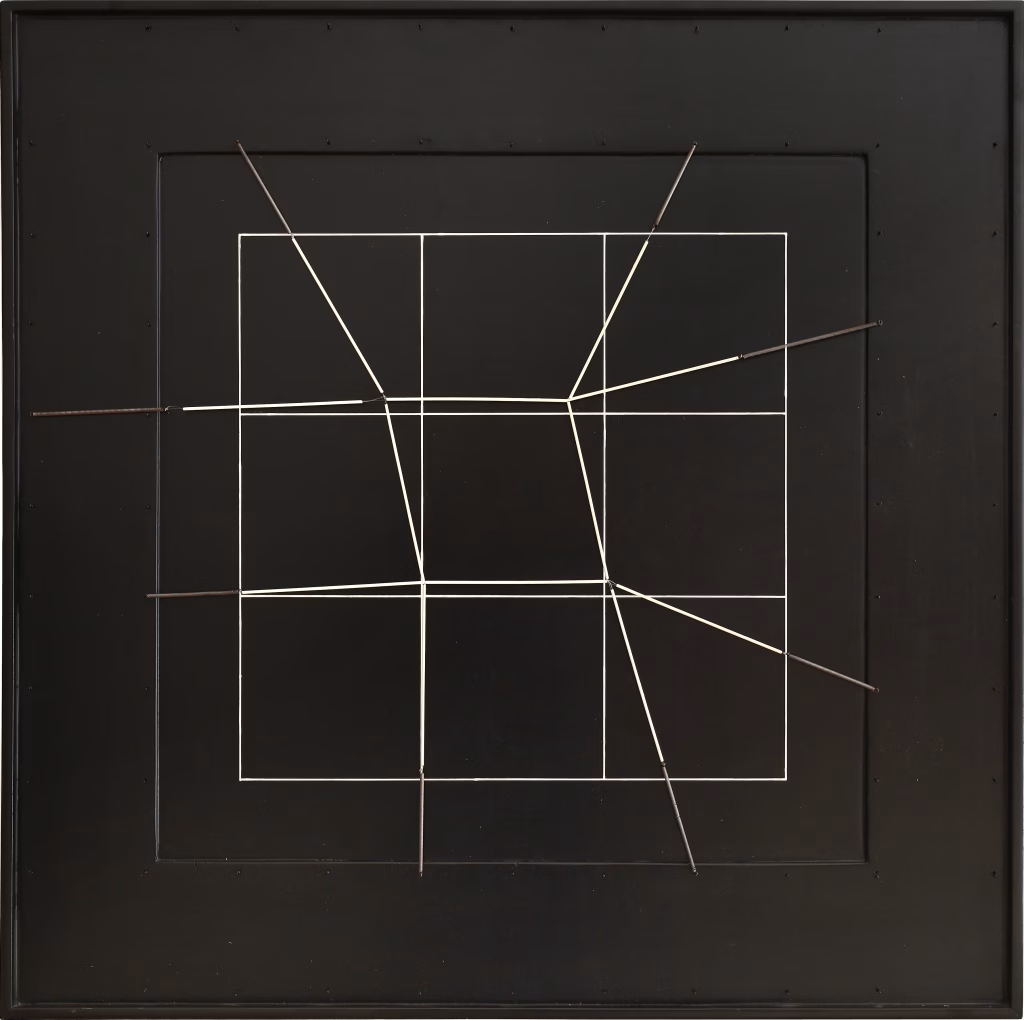
Gianni Colombo (1937 – 1993 Milan, Italy) is regarded as one of the foremost Italian artists of the post-war avant-garde, notable for his pioneering work in kinetic art and as a leading figure in the Arte Programmata movement. Between 1959 and 1960, he co-founded the T Group, closely connected to the international Nouvelle Tendence movement, which explored the intersection of art, science, and perception. Colombo’s first solo exhibition was presented at Galleria Pater, Milan in 1960, marking the beginning of a career characterized by the integration of technology, physics, and visual experimentation.
Colombo’s work is distinguished by its systematic engagement with scientific and technological principles. He employed mechanical, electrical, and magnetic devices, as well as industrial neon lights and lasers, to create dynamic artworks that foregrounded movement, light, and spatial interaction. In the 1960s, he extended this research to experimental films, kinetic objects, and immersive environments designed to actively involve the spectator, transforming the viewer from passive observer into participant. This interactivity became a hallmark of his practice, exploring the perceptual thresholds of space, time, and bodily experience.
Throughout his career, Colombo exhibited extensively in Italy and internationally, gaining recognition for both his experimental rigor and conceptual innovation. In 1985, he was appointed director of the Brera Academy, where he taught structuration of space, shaping a new generation of artists in the integration of spatial dynamics and perception. Beyond teaching, he engaged in avant-garde scenography, including the Operstheater of Frankfurt (1986), and developed virtual and conceptual architectural projects such as Architetture cacogoniometriche (1988) and Spazi curvi (1992), which explored the deformation of space and the perception of curvature in controlled environments.
Among his major accolades, Colombo was awarded the Venice Biennale Prize in 1968, cementing his reputation as a central figure in the international kinetic and technological art movements. His legacy lies in the seamless fusion of artistic, scientific, and architectural thinking, producing works that challenge perception, invite participation, and redefine the experience of space.
For information on available works by the artist, please contact the gallery.